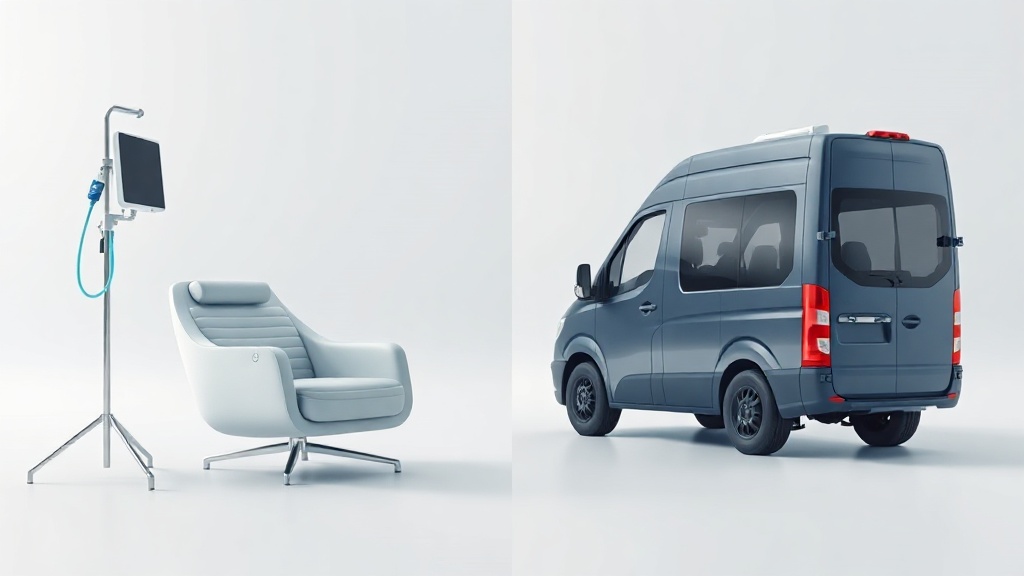
IV bar vs. mobile drip operator: marketing strategy differences
Brick-and-mortar IV bars and mobile IV operators look similar but require very different marketing approaches. Channel mix, content, and conversion patterns compared.
How does marketing for an IV bar differ from marketing for a mobile IV operator?
An IV bar (brick-and-mortar clinic with a physical address) and a mobile IV operator (service delivered to the patient’s location) target overlapping but distinct buyer segments. IV bars compete primarily on convenience radius and Google Map Pack visibility. Mobile operators compete on response time, service area breadth, and premium-experience positioning. The two require different channel mixes, different content, and different KPI structures.
Different buyer psychology
IV bar patients typically search and book the same day with high urgency: hangover, jetlag, immune support before travel. Their decision criteria are usually proximity (“closest open IV bar”), price (visible on the menu before booking), and the social signal of reviews (‘good vibes’ factor).
Mobile IV patients have different urgency. They are willing to pay premium for the at-home or in-hotel convenience. They book further in advance (rare same-hour bookings, more common same-day or next-day). Their decision criteria are response time (will the operator actually show up when promised), discretion (no traveling to a clinic), and the experience (a professional in scrubs arriving to your home is different from a Walgreens visit).
Channel mix differences
Channels that favor IV bars
Google Map Pack: dominant. Brick-and-mortar listings outrank service-area businesses in the local pack.
Local Services Ads (where eligible): excellent fit for brick-and-mortar.
Walk-in / drive-by traffic: only available to IV bars.
Local print, billboard, transit ads: occasionally valuable for established bars in dense metros.
Channels that favor mobile operators
Google Search Ads on “mobile IV” intent: dominant. Standard search ads convert higher for mobile operators than Map Pack does.
Instagram and TikTok organic: mobile operators can produce visual content showing at-home delivery that no brick-and-mortar bar can match.
Hotel + event partnerships: more native fit for mobile, since the value prop is “come to where the customer already is.”
Influencer partnerships: mobile operators benefit more from a local influencer posting about an at-home IV session than a brick-and-mortar bar does from a clinic visit.
Content strategy differences
IV bar content typically focuses on menu visibility (what drips are available), location detail (parking, hours, accessibility), team and atmosphere (“why visit us vs. the IV bar two blocks away”), and integration into walkable local lifestyle (post-yoga, post-brunch, etc.).
Mobile operator content focuses on the experience anatomy (what happens when you book, what arrives, how long it takes, what the cleanup looks like), trust signals around in-home medical service (insurance, nurse credentials, sanitation protocols), and use-case content (after-flight recovery in your hotel, wedding morning prep at home, post-event recovery).
Pricing visibility decisions
IV bars almost always show pricing prominently. Menu boards in the lobby, pricing on the website, pricing in the booking flow. Patients who walk in expect to see prices.
Mobile operators have more flexibility. The premium positioning of at-home delivery supports either showing prices (transparency, filters out price-sensitive customers) or hiding them behind “book a free consult” (signals concierge, captures the contact info). The right answer depends on positioning.
KPI structure differences
IV bar KPIs: same-day bookings as percent of total, walk-in conversion rate, drips per chair-hour, average ticket including upsells, repeat patient rate at 30/60/90 days.
Mobile operator KPIs: inbound inquiry response time, lead-to-booking conversion rate, average drip in inner ring vs. outer ring, B2B partnership pipeline coverage, weekly recurring patient count.
The hybrid model
Some operators run both. Open a brick-and-mortar IV bar, then add mobile service as an add-on for premium pricing. Marketing each requires its own positioning. Mixing them on the same website without clear separation usually confuses both segments and underperforms.
The clean structure: brick-and-mortar gets the main brand and location pages. Mobile gets a separate landing page (‘At-home concierge IV’) with its own pricing, its own booking flow, and its own visual identity. Patients self-select into the channel that fits them.
Can a brick-and-mortar IV bar effectively add mobile service?
Yes, but treat it as a separate product. Different marketing, different pricing, different operational workflow. Trying to bolt mobile onto an existing IV bar with the same pricing structure and the same scheduling tool usually underperforms.
What if I am opening soon and have not decided between IV bar or mobile?
Pick based on capital availability and patience. IV bars require $150K-400K to open and run. Mobile requires $25K-60K. Mobile generates revenue faster but plateaus lower without scaling to multiple operators. IV bars compound over years.
Need someone who has done this for IV clinics before?
A 15-minute Discovery Call is the fastest way to scope whether IVTM is the right fit for what your clinic needs next.